Contract Season Is Your Staffing Strategy
It's that time of year again.
Letters have gone out. Contract decisions are due. And if you're like most principals, you're feeling the weight of every stakeholder simultaneously pressing in on you from every direction.
Your teachers are waiting. Their livelihoods are on the line and they know it. Your students are counting on continuity. Their education hangs in the balance of decisions you're making right now. Your families are watching. They're paying for a Christian education and they have high expectations for what that looks like. Your board is asking two questions on repeat: Can we afford this? And what does enrollment look like next year?
And in the middle of all of it, you're trying to lead with integrity, pray for wisdom, and make decisions that honor everyone.

Here's the honest truth: you can't make everyone happy. But you can make decisions you can defend. Decisions anchored in something more solid than gut instinct and a curriculum calendar.
That's what the Proximity Staffing Plan gives you.
The Problem With How Most Principals Approach Contract Season
Without a clear plan, contract renewal decisions default to social pressure. You scan your roster and mentally highlight the names you can't afford to lose. You renew whoever you can afford and cut whoever the budget forces you to cut. The loudest voices, the most visible relationships, and the most urgent scheduling gaps drive the decisions.
It feels like leadership. But it's mostly reaction.
And here's what makes it worse: it's hard to back up decisions when you don't have a plan to point to. When a teacher asks why their contract wasn't renewed, "the budget" is a weak answer. When your board questions a hire, "I had a good feeling about them" doesn't build confidence.
Over time, those accumulated decisions drift your staffing map further from mission. You end up with a roster built around relationships and reaction rather than strategy and clarity.
Contract season deserves better than that. So does your staff.
The Proximity Staffing Plan
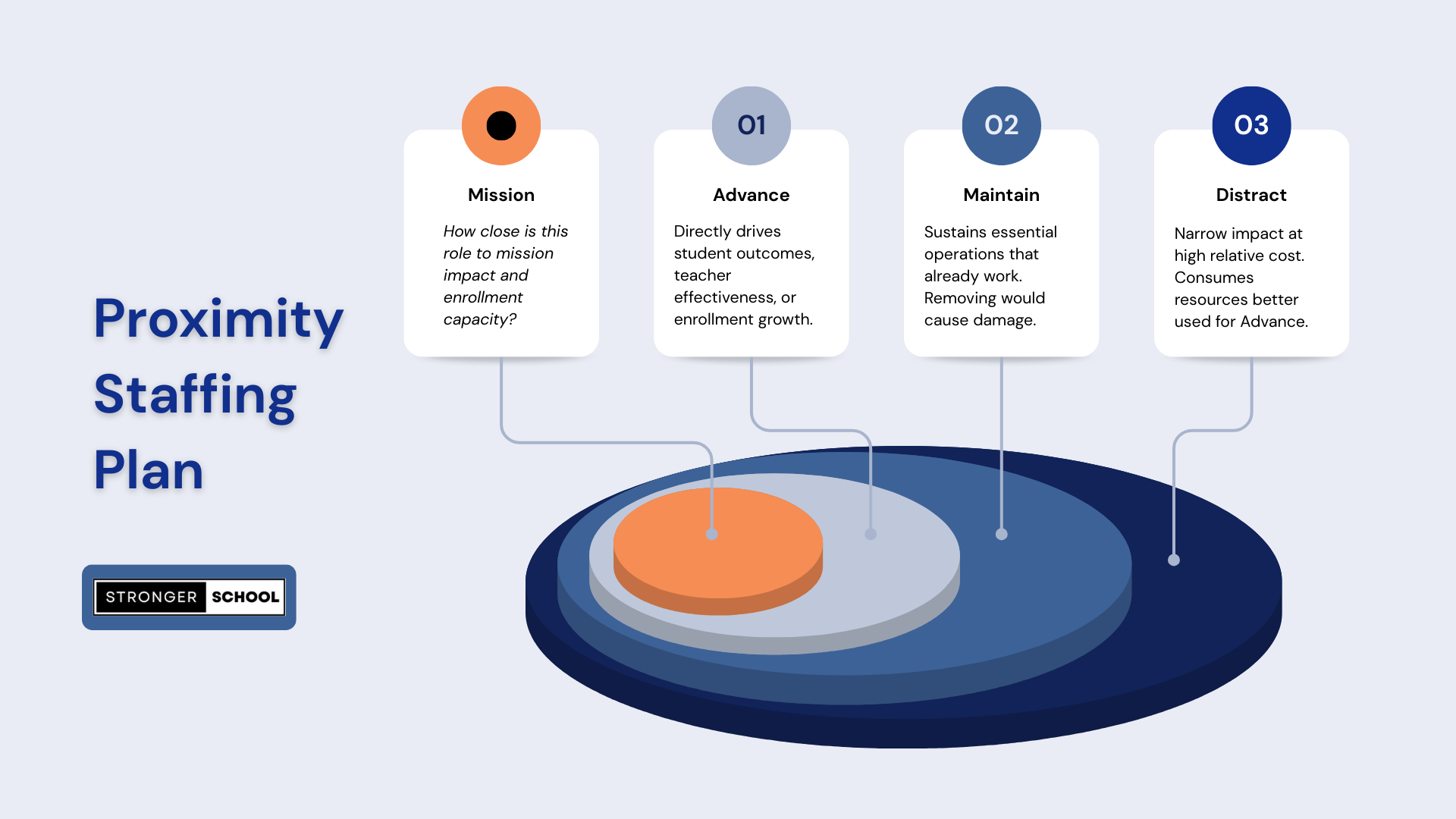
Every role in your school, and every contract renewal decision, can be filtered through one foundational question:
How close is this role to mission impact and enrollment capacity?
That question produces three categories.
Advance
This role directly improves student outcomes, makes teachers measurably more effective, or frees a mission-critical leader to perform at their highest level. It increases the school's capacity to grow and serve more students.
A teacher whose elective attracts new families advances mission. A principal's assistant who frees you to lead, recruit, and cast vision advances mission. A director of admissions who converts inquiries into enrolled students advances mission.
Renew these roles urgently. Protect them fiercely during budget conversations.
Maintain
This role sustains something essential that's already working. It doesn't grow the school but removing it would cause real damage. Core classroom teachers. Finance staff who keep the budget honest. Roles that hold the foundation steady while Advance roles build upward.
Renew these roles with clear eyes. Revisit them when your health metrics shift. A Maintain role at one school is a Distract role at another, depending on where the school is and where it's heading.
Distract
This role serves a narrow need at a cost disproportionate to its mission impact. It feels mission-aligned because real students are being served. But it doesn't move the school's capacity forward and it consumes budget that could fund a hire with school-wide leverage.
This is the hardest category to act on. Not because the decision is unclear but because the person in the role is real, the students they serve are real, and cutting the role feels like abandoning both.
But here's what's also real: every dollar invested in a Distract role is a dollar not invested in Advance. That's a stewardship decision with long-term consequences for every student your school could serve but currently can't reach.
The Category Isn't In The Role. It's In Your Reality.
This is where the plan does its most important work.
A reading interventionist serving ten students isn't automatically a Distract hire. If your school is wrestling with literacy-driven attrition, that role might be your most important Maintain investment right now. But if retention isn't your primary challenge and enrollment capacity is, that same role may be pulling resources from where your mission needs them most.
You can't apply this plan honestly without knowing your school's current health metrics. Where are you losing students? What's blocking enrollment growth? What's driving your best teachers to stay or leave? The data determines the category. The category drives the decision.
This is also where the plan becomes a gift to your staff, not just your budget.
Every person on your team deserves to know why their role matters to the mission. When you can look a teacher or staff member in the eye and say clearly, "Here's how what you do every day advances what we're building," you honor them. You get better work from them. And you build a culture where mission isn't a poster on the wall. It's the reason everyone shows up.
What This Looks Like Two Years From Now
Schools that make contract renewal decisions without this plan end up playing a game of scarcity. They scan their roster looking for names they can't lose. They hold on. They react. They protect what they have rather than building toward what's next.
Schools that apply the Proximity Staffing Plan consistently know three things: where they are going, how they are getting there, and who they need to get there. They aren't scrambling to hold their roster together. They're building toward something. They aren't white-knuckling every contract season. They're making strategic decisions with confidence and clarity.
That's the difference between a school trapped by its current roster and a school positioned for its next chapter.
Contract season isn't just an administrative obligation. It's your most concentrated moment of staffing strategy all year. The decisions you make in the next few weeks will shape your school's mission capacity for the next two to three years.
Look at every role through the lens of proximity to mission and capacity to grow.
Your staff deserves to know their work matters. Your students deserve a school staffed for their flourishing.